
FOR THE FIELD SUPERVISOR
Chem Script
Per-site chemistry checks that flag bad readings.
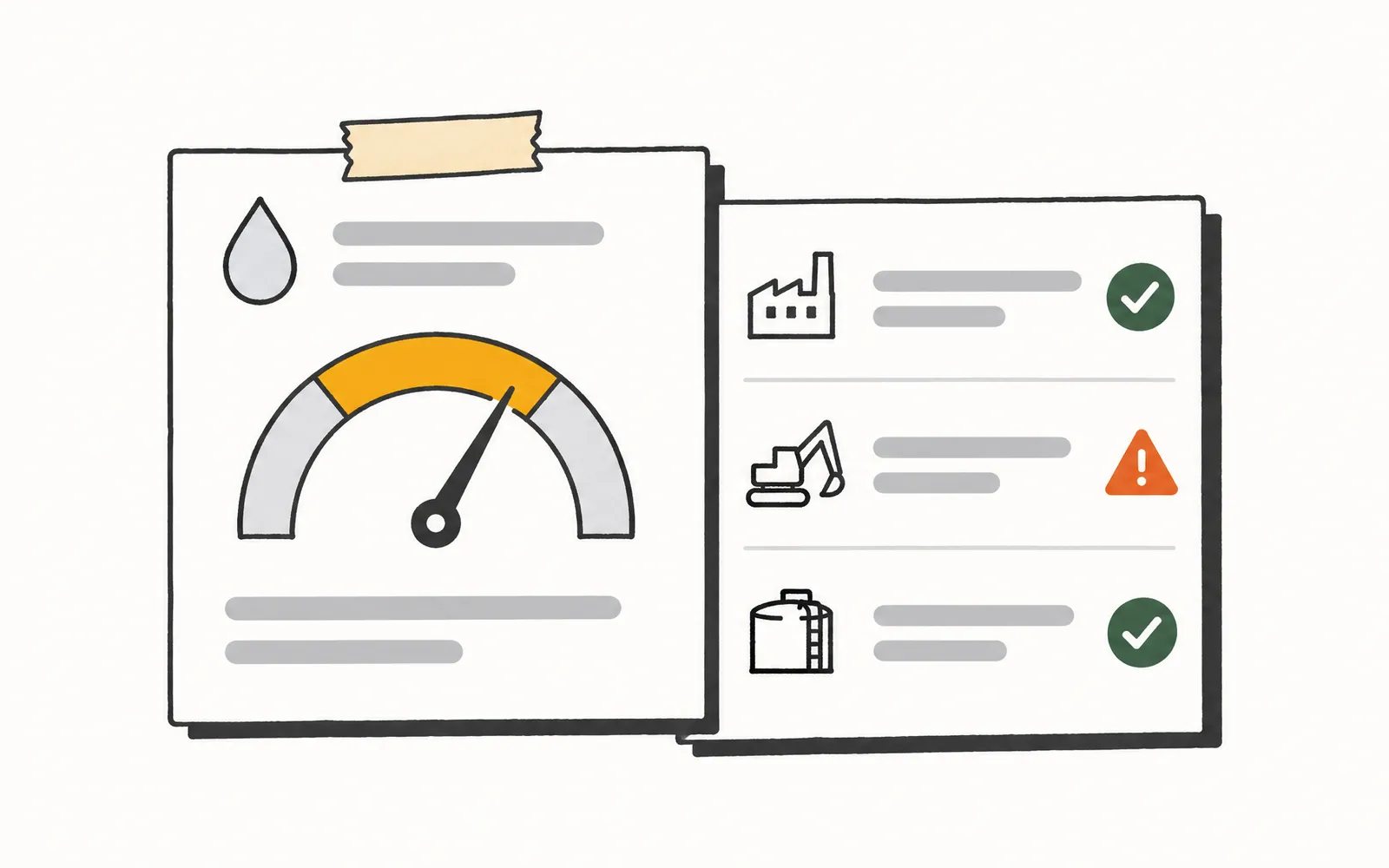
Every site on the route is held to the chemical standards that the supervisor sets, and the ones that drift are flagged before the visit. The supervisor no longer has to carry each site's target ranges in their head or read the numbers one by one.
- Time back
- 3 min
- per appointment
- Cost
- 6¢
- 12 Rivets per appointment
How it works.
5 steps, and your team only touches the ones that need a person.
- 1.
Write a script for each site
The field supervisor sets each site's target ranges, dosing rules, trigger thresholds, and seasonal or conditional overrides once, and updates them as the site changes. A site is whatever the operation treats: a pool, a fountain, a cooling tower, a pest-control account, a facility sanitation program.
- 2.
Capture readings at the visit
The route tech opens the site's active script and records the visit's readings against it.
- 3.
Check on submission
When the tech submits, Chem Script compares every reading to that site's script and flags anything outside the defined range.
- 4.
Review only what drifted
The field supervisor sees the flagged visits and reviews them; the in-range visits pass without needing a look.
- 5.
Keep it with the visit record
When the field management system is connected, Chem Script seeds the first script from existing chemistry history, opens the right site's script from the job, and writes the readings and flags back to the visit record.
Try it.
A small working model of Chem Script. Nothing here touches a real customer.
Pick a pool or a cooling tower, nudge the readings, and see which ones fall outside that site's ranges.
A day for the Field Supervisor.
- 7:00 AM
The field supervisor pulls up the day's route. Dozens of sites, each with its own target ranges. Tries to keep straight which ones run hot and which ones to watch.
- 12:00 PM
Readings come in through the morning. The supervisor scans a handful from memory, comparing numbers to what each site should be. Most visits go unchecked; there is not time for all of them.
- 3:00 PM
One site's sanitizer was low again. Nobody flagged it. The reading was right there in the submission, but no one compared it to the standard.
- 5:30 PM
A customer calls about a fouled, out-of-spec system. The supervisor goes back through the week's readings by hand to work out when it started to drift.
- 7:00 AM
The supervisor opens the route. Every site already carries its own script. Nothing to memorize.
- 12:00 PM
Techs record readings against each site's script through the morning. The in-range visits pass quietly. The two that drifted are already flagged and waiting.
- 12:05 PM
The supervisor opens the flagged visits, sees exactly which reading is off and by how much, sets a dosing adjustment on one site and a re-check on the other.
- 5:30 PM
The route closes out with every visit checked against its standard. The site that would have gone out of spec was caught at noon, not from a callback a week later.
What it won't do.
So nobody's surprised later.
- Does not dose chemicals or control treatment equipment.
- Does not diagnose why a reading is out of range or prescribe a fix beyond the thresholds the supervisor set.
- Does not schedule, dispatch, or route visits.
- Does not author or certify regulatory compliance records.


- About 220,000 calls a month analyzed across 31 shops
- 139 shops use Graphite Lab tools
- 108 ServiceTitan data types synced, including for multi-location operators
- 66 to 93 mobile PageSpeed, from a contractor's old site to the preview we built in under 10 days
Let’s talk about your shop.
No slide deck. Tell us how your team runs today and we'll show you what we'd build first. If it's a fit, we send you a quote.